February 2, 2026 | A Journey to Reconceptualize the Presence of Others in Child Abuse, by Bella Klebanov
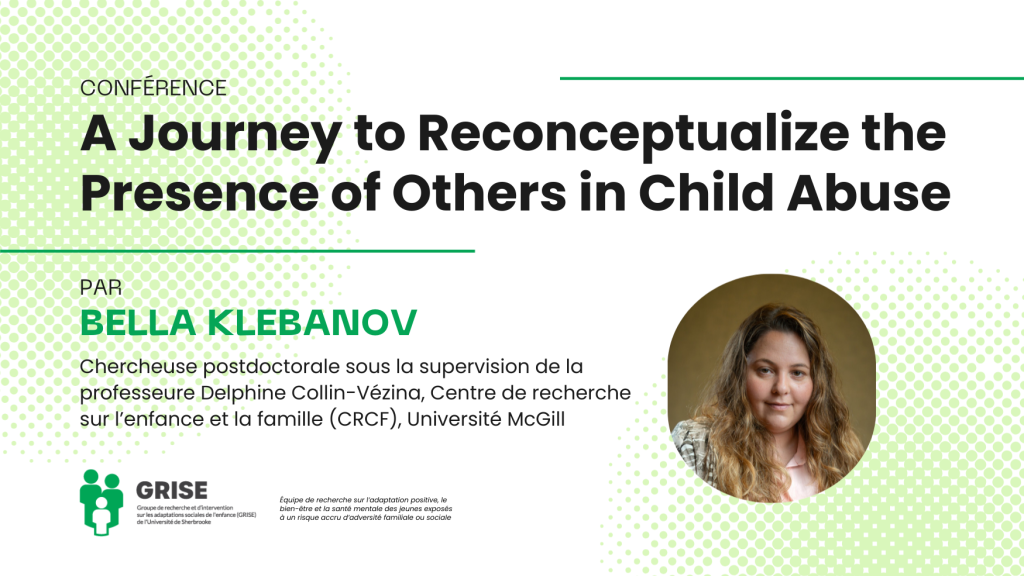
Lunchtime conference on Monday, February 2, 2026, from 11:45 am to 12:45 pm Teams, jointly organized by Groupe de recherche et d’intervention sur les adaptations sociales de l’enfance (GRISE) and the Research team on positive adaptation, well-being and mental health of youth at increased risk of family or social adversity.
Guest speaker : Bella Klebanov, Postdoctoral Fellow under the supervision of Prof. Delphine Collin-Vézina, Centre for Research on Children and Families, McGill University.
Conference abstract : This presentation will explore the phenomenon of “significant others” who are present during intrafamilial child abuse, and the profound implications of their presence. Across five studies, including systematic literature review, forensic interview analyses, retrospective adult testimonies, and an in-depth qualitative interview analysis, the findings reveal that abuse in the family rarely occurs in isolation, and Others often see, hear, suspect, or know the abuse. It will examine the complex terrain between external witnessing and the absence of acknowledgment, and how this gap influences children’s developing internal narratives, including the ways they come to understand, question, or hold their own experiences. Drawing on conceptual frameworks of witnessing, testimony, and broader social-ethical perspectives, the talk will reflect on how external recognition, or its absence, intersects with processes of meaning-making, memory, and the search for validation across the life span.
Biographical Note : Bella Klebanov is a social work scholar whose research grew out of frontline practice with refugee children and families, experiences that shaped her commitment to bridging practice with academic research to better understand and respond to the complex realities of child abuse and maltreatment. Her PhD at Tel Aviv University, under the supervision of Prof. Carmit Katz, examined the presence and roles of significant others during intrafamilial child sexual abuse, highlighting how family dynamics, others’ responses, and societal silences shape children’s experiences of trauma and recovery. Alongside her doctoral research, she was an active member of Professor Carmit Katz’s research team, contributing to studies on the coexistence of love and abuse within abusive families, children’s experiences of polyvictimization, and the particular vulnerabilities of children with disabilities who experienced sexual abuse. Her current work focuses on multigenerational involvement in child‑protection systems, aiming to identify structural “blind spots” that perpetuate cycles of vulnerability and to develop collaborative, evidence‑based approaches that enhance trust between families and child‑protection services.